
AMC 8 2025

Instructions

  1. This is a 25-question, multiple choice test. Each question is followed by answers marked A, B, C, D and E. Only one of these is correct.
  2. You will receive 1 point for each correct answer. There is no penalty for wrong answers.
  3. No aids are permitted other than plain scratch paper, writing utensils, ruler, and erasers. In particular, graph paper, compass, protractor, calculators, computers, smartwatches, and smartphones are not permitted.
  4. Figures are not necessarily drawn to scale.
  5. You will have 40 minutes working time to complete the test.

The eight-pointed star, shown in the figure below, is a popular quilting pattern. What percent of the entire $4\times4$ grid is covered by the star?
 
 
$\textbf{(A)}\ 40 \qquad \textbf{(B)}\ 50 \qquad \textbf{(C)}\ 60 \qquad \textbf{(D)}\ 75 \qquad \textbf{(E)}\ 80$

$\textbf{B}$
 
The area of the grid is 16. The area of the unshaded region is $4\times1+8\times0.5=8$. So the star covers $\dfrac{16-8}{16}=50\%$ of the grid.

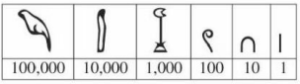
The table below shows the Ancient Egyptian hieroglyphs that were used to represent different numbers. 
 
 
For example, the number $32$ was represented by the hieroglyphs $\cap \cap \cap ||$. What number is represented by the following combination of hieroglyphs?
 
 
$\textbf{(A)}\ 1,423 \qquad \textbf{(B)}\ 10,423 \qquad \textbf{(C)}\ 14,023 \qquad \textbf{(D)}\ 14,203 \qquad \textbf{(E)}\ 14,230$

$\textbf{B}$

The first hieroglyph is worth $10,000$, the next four are worth $100 \times 4 = 400$, then the next two are worth $10 \times 2 = 20$, and the last three are worth $1 \times 3 = 3$. Therefore, the answer is $10,000 + 400 + 20 + 3 = 10,423$.

Buffalo Shuffle-o is a card game in which all the cards are distributed evenly among all players at the start of the game. When Annika and $3$ of her friends play Buffalo Shuffle-o, each player is dealt $15$ cards. Suppose $2$ more friends join the next game. How many cards will be dealt to each player?
 
$\textbf{(A)}\ 8 \qquad \textbf{(B)}\ 9 \qquad \textbf{(C)}\ 10 \qquad \textbf{(D)}\ 11 \qquad \textbf{(E)}\ 12$

$\textbf{C}$
 
The total number of cards is $4\times15=60$. If 2 more friends join the game, there will be 6 player, and each player should be dealt $60/6=10$ cards.

Lucius is counting backward by $7$s. His first three numbers are $100$, $93$, and $86$. What is his $10$th number?
 
$\textbf{(A)}\ 30 \qquad \textbf{(B)}\ 37 \qquad \textbf{(C)}\ 42 \qquad \textbf{(D)}\ 44 \qquad \textbf{(E)}\ 47$

$\textbf{B}$
 
The numbers he counted form an arithmetic sequence with the first term $a_1=100$ and the common difference $d=-7$. So the tenth number in the sequence is $100-7\times9=37$.

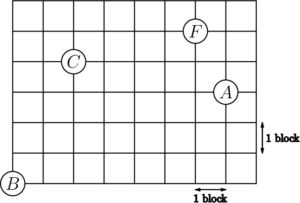
Betty drives a truck to deliver packages in a neighborhood whose street map is shown below. Betty starts at the factory (labled $F$) and drives to location $A$, then $B$, then $C$, before returning to $F$. What is the shortest distance, in blocks, she can drive to complete the route?
 
 
$\textbf{(A)}\ 20 \qquad \textbf{(B)}\ 22 \qquad \textbf{(C)}\ 24 \qquad \textbf{(D)}\ 26\qquad \textbf{(E)}\ 28$

$\textbf{C}$
 
She needs to drive $2+1=3$ blocks to reach point $A$, then $3+7=10$ blocks to reach point $B$, and $4+2=6$ blocks to reach point $C$, and finally $1+4=5$ blocks to return to point $F$. The total number of blocks is $3+10+6+5=24$.

Sekou writes the numbers $15, 16, 17, 18, 19.$ After he erases one of his numbers, the sum of the remaining four numbers is a multiple of $4.$ Which number did he erase?
 
$\textbf{(A)}\ 15\qquad \textbf{(B)}\ 16\qquad \textbf{(C)}\ 17\qquad \textbf{(D)}\ 18\qquad \textbf{(E)}\ 19$

$\textbf{C}$
 
The sum of all five numbers is $15+16+17+18+19=85$, which satisfies $85\equiv1\pmod4$. Hence, the number he erased must be also congruent to $1$ modulo $4$. The only possible number is 17. 

On the most recent exam on Prof. Xochi's class,
 
$\bullet\quad5$ students earned a score of at least $95\%\newline$
$\bullet\quad13$ students earned a score of at least $90\%\newline$
$\bullet\quad27$ students earned a score of at least $85\%\newline$
$\bullet\quad50$ students earned a score of at least $80\%$
 
How many students earned a score of at least $80\%$ and less than $90\%$?
 
$\textbf{(A)}\ 8\qquad \textbf{(B)}\ 14\qquad \textbf{(C)}\ 22\qquad \textbf{(D)}\ 37\qquad \textbf{(E)}\ 45$

$\textbf{D}$
 
$50$ people scored at least $80\%$, and out of these $50$ people, $13$ of them earned a score that was not less than $90\%$, so the number of people that scored in between at least $80\%$ and less than $90\%$ is $50-13 = 37$.

Isaiah cuts open a cardboard cube along some of its edges to form the flat shape shown on the right, which has an area of $18$ square centimeters. What is the volume of the cube in cubic centimeters?
 
 
$\textbf{(A)}~3\sqrt{3}\qquad\textbf{(B)}~6\qquad\textbf{(C)}~9\qquad\textbf{(D)}~6\sqrt{3}\qquad\textbf{(E)}~9\sqrt{3}$

$\textbf{A}$
 
Each of the $6$ faces of the cube have equal area, so the area of each face is $\dfrac{18}{6} = 3\ \text{cm}^2$, making the side length $\sqrt3\ \text{cm}$. From this, we can see that the volume of the cube is $\left(\sqrt{3}\right)^3 = 3\sqrt{3}\ \text{cm}^3$.

Ningli looks at the $6$ pairs of numbers directly across from each other on a clock. She takes the average of each pair of numbers. What is the average of the resulting $6$ numbers?


$\textbf{(A)}\ 5\qquad \textbf{(B)}\ 6.5\qquad \textbf{(C)}\ 8\qquad \textbf{(D)}\ 9.5 \qquad \textbf{(E)}\ 12$

$\textbf{B}$

\begin{align*}
\frac{\frac{1+7}{2} + \frac{2+8}{2} + \cdots + \frac{6+12}{2}}{6} &= \frac{1+2+3+\cdots+12}{2 \cdot 6}\\
&= \frac{\frac{1}{2}\cdot12 \cdot 13}{2 \cdot 6}\\
&= \frac{13}{2}\\
&= 6.5
\end{align*}

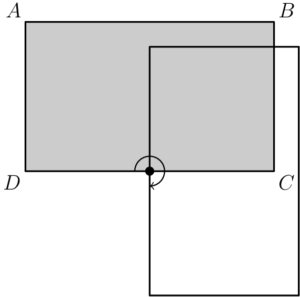
In the figure below, $ABCD$ is a rectangle with sides of length $AB = 5$ inches and $AD$ = $3$ inches. Rectangle $ABCD$ is rotated $90^\circ$ clockwise around the midpoint of side $DC$ to give a second rectangle. What is the total area, in square inches, covered by the two overlapping rectangles?
 
 
$\textbf{(A)}\ 21 \qquad \textbf{(B)}\ 22.25 \qquad \textbf{(C)}\ 23 \qquad \textbf{(D)}\ 23.75 \qquad \textbf{(E)}\ 25$

$\textbf{D}$
 
The area of each rectangle is $5 \times 3 = 15$ square inches. Then the sum of the areas of the two regions is the sum of the areas of the two rectangles minus the area of their overlap. To find the area of the overlap, we note that the region of overlap is a square, each of whose sides have length $2.5$ inches (half of side $CD$). Hence, the answer is $15+15-2.5^2=23.75$.

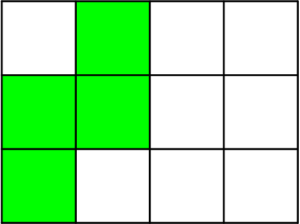
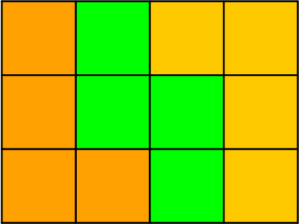
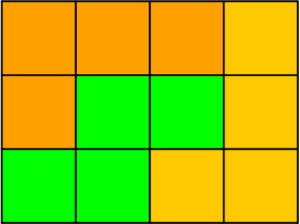
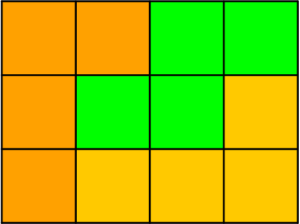
A $\textit{tetromino}$ consists of four squares connected along their edges. There are five possible tetromino shapes, $I$, $O$, $L$, $T$, and $S$, shown below, which can be rotated or flipped over. Three tetrominoes are used to completely cover a $3\times4$ rectangle. At least one of the tiles is an $S$ tile. What are the other two tiles?
 
 
$\textbf{(A) }I$ and $L\qquad \textbf{(B) } I$ and $T\qquad \textbf{(C) } L$ and $L\qquad \textbf{(D) }L$ and $S\qquad \textbf{(E) }O$ and $T$

$\textbf{C}$
 
The $3\times4$ rectangle allows for $7$ possible places to put the $S$ piece, with each possible placement having an inverted version. One of the cases looks like this:
 
 
As you can see, there is a hole in the top left corner of the board, which would be impossible to fill using the tetrominos. There are three cases in which a hole isn't created, as shown below:


For each of the inverted cases, the $L$ pieces can be inverted along with the $S$ piece. Because the only cases that fill the rectangle after the $S$ is placed are the ones that use two L pieces, the answer must be D.

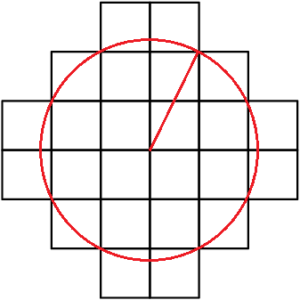
The region shown below consists of 24 squares, each with side length 1 centimeter. What is the area, in square centimeters, of the largest circle that can fit inside the region, possibly touching the boundaries?
 
 
$\textbf{(A)}\ 3\pi\qquad \textbf{(B)}\ 4\pi\qquad \textbf{(C)}\ 5\pi\qquad \textbf{(D)}\ 6\pi\qquad \textbf{(E)}\ 8\pi$

$\textbf{C}$
 
 
The largest circle that can fit inside the figure has its center in the middle of the figure and will be tangent to the figure in $8$ points, as shown above. By the Pythagorean Theorem, the distance from the center to one of these $8$ points is $\sqrt{2^2 + 1^2} = \sqrt5$, so the area of this circle is $\pi\left(\sqrt5\right)^2=5\pi$.

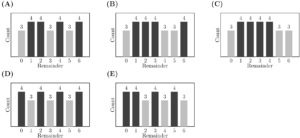
Each of the even numbers $2, 4, 6, \ldots, 50$ is divided by $7$. The remainders are recorded. Which histogram displays the number of times each remainder occurs?

 

$\textbf{A}$
 
Since $\gcd(2,7)=1$, we conclude that any 7 consecutive elements in the set $\{2, 4, 6, \ldots, 50\}$ is the complete residue system modulo $7$. For example, let's take the numbers 2 through 14. The remainders will be 2, 4, 6, 1, 3, 5, and 0. This sequence keeps repeating itself over and over. 
 
There are 25 elements in the set. We can divide them into $\{2, 4, 6, \ldots, 14\}$ $\{16, 18, 20, \ldots, 28\}$ $\{30, 32, 34, \ldots, 42\}$ and $\{44, 46, 48, 50\}$. The remainders of the last set (2, 4, 6, 1) will appear 4 times. The other remainders (3, 5, 0) will appear 3 times. So the answer is A.

A number $N$ is inserted into the list $2, 6, 7, 7, 28$. The mean is now twice as great as the median. What is $N$?
 
$\textbf{(A)}\ 7\qquad \textbf{(B)}\ 14\qquad \textbf{(C)}\ 20\qquad \textbf{(D)}\ 28\qquad \textbf{(E)}\ 34$

$\textbf{E}$
 
For the original list $\{2, 6, 7, 7, 28\}$, the median is 7, and the mean is $\dfrac{2+6+7+7+28}{5}=10$. 
 
If $N<7$, then the median of the new list is less than 7, but no less than $\dfrac{6+7}2=6.5$. However, the mean of the new list will be less than the original mean (10). In this case the new mean can not be twice as great as the median.
 
Therefore, $N$ must be no less than 7. In this case the median of the new list is $7$, so the mean of the new list will be $7 \times 2 = 14$. Hence, we get $$\dfrac{2+6+7+7+28+N}{6}=14\rightarrow N=34$$

Kei draws a $6$-by-$6$ grid. He colors $13$ of the unit squares silver and the remaining squares gold. Kei then folds the grid in half vertically, forming pairs of overlapping unit squares. Let $m$ and $M$ equal the least and greatest possible number of gold-on-gold pairs, respectively. What is the value of $m+M$?
 
 
$\textbf{(A)}\ 12\qquad \textbf{(B)}\ 14\qquad \textbf{(C)}\ 16\qquad \textbf{(D)}\ 18 \qquad \textbf{(E)}\ 20$

$\textbf{C}$
 
There are $6\times6=36$ unit squares in total, and 13 of them are silver, so the rest $36-13=23$ unit squares are gold. Hence, the maximum number of gold-on-gold pairs is $M=\left\lfloor\dfrac{23}{2}\right\rfloor=11$.
 
The minimum number of gold-on-gold pairs occurs when each silver unit square is paired with a gold, and the remaining $23-13=10$ gold unit squares are in pairs. So the minimum number is $m=\dfrac{10}{2}=5$.
 
Therefore, the answer is $m+M=5+11=16$.

Five distinct integers from $1$ to $10$ are chosen, and five distinct integers from $11$ to $20$ are chosen. No two numbers differ by exactly $10$. What is the sum of the ten chosen numbers?

 
$\textbf{(A)}\ 95\qquad \textbf{(B)}\ 100\qquad \textbf{(C)}\ 105\qquad \textbf{(D)}\ 110\qquad \textbf{(E)}\ 115$

$\textbf{C}$
 
Note that for no two numbers to differ by $10$, every number chosen must have a different units digit. To make computations easier, we can choose $(1, 2, 3, 4, 5)$ from the first group and $(16, 17, 18, 19, 20)$ from the second group. Then the sum of the ten chosen numbers is $1+2+3+4+5+16+17+18+19+20 = 105$.

In the land of Markovia, there are three cities: $A$, $B$, and $C$. There are $100$ people who live in $A$, $120$ who live in $B$, and $160$ who live in $C$. Everyone works in one of the three cities, and a person may work in the same city where they live. In the figure below, an arrow pointing from one city to another is labeled with the fraction of people living in the first city who work in the second city. (For example, $\dfrac{1}{4}$ of the people who live in $A$ work in $B$.) How many people work in $A$?
 
 
$\textbf{(A)}\ 55\qquad \textbf{(B)}\ 60\qquad \textbf{(C)}\ 85\qquad \textbf{(D)}\ 115\qquad \textbf{(E)}\ 160$

$\textbf{D}$
 
There are $100\times\left(1-\dfrac14-\dfrac15\right)=55$ people who live in city $A$ and also work in city $A$, $120\times\dfrac13=40$ people who live in city $B$ but work in city $A$, and $160\times\dfrac18=20$ people who live in city $C$ but work in city $A$. So the total number of people working in city $A$ is $55+40+20=115$. 

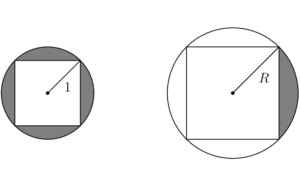
The circle shown below on the left has a radius of 1 unit. The region between the circle and the inscribed square is shaded. In the circle shown on the right, one quarter of the region between the circle and the inscribed square is shaded. The shaded regions in the two circles have the same area. What is the radius $R$, in units, of the circle on the right?
 
 
$\textbf{(A)}\ \sqrt2\qquad \textbf{(B)}\ 2\qquad \textbf{(C)}\ 2\sqrt2\qquad \textbf{(D)}\ 4\qquad \textbf{(E)}\ 4\sqrt2$

$\textbf{B}$
 
The area of the shaded region in the circle on the left is the area of the circle minus the area of the square $$\pi(1)^2-(\sqrt2)^2=\pi-2$$ The shaded area in the circle on the right is the area of the circle minus the area of the square, then multiplied by $\dfrac{1}{4}$ $$\dfrac14\left[\pi R^2-\left(\sqrt2R\right)^2\right]=\dfrac{R^2(\pi-2)}{4}$$ Since the shaded areas are equal to each other, we have $$\pi-2=\dfrac{R^2(\pi-2)}{4}\rightarrow R=2$$

Two towns, $A$ and $B$, are connected by a straight road, $15$ miles long. Traveling from town $A$ to town $B$, the speed limit changes every $5$ miles: from $25$ to $40$ to $20$ miles per hour (mph). Two cars, one at town $A$ and one at town $B$, start moving toward each other at the same time. They drive at exactly the speed limit in each portion of the road. How far from town $A$, in miles, will the two cars meet?
 
 
$\textbf{(A)}\ 7.75\qquad \textbf{(B)}\ 8\qquad \textbf{(C)}\ 8.25\qquad \textbf{(D)}\ 8.5\qquad \textbf{(E)}\ 8.75$

$\textbf{D}$
 
It takes Car $A$ $\dfrac{5\ \text{mi}}{25\ \text{mph}}=\dfrac15\ \text{hour}=12\ \text{minute}$ to travel the first 5 miles from town $A$ to town $B$. Similarly, it takes Car $B$ $\dfrac{5\ \text{mi}}{20\ \text{mph}}=\dfrac14\ \text{hour}=15\ \text{minutes}$ to travel the first 5 miles from town $B$ to town $A$.
 
We see that Car $A$ has traveled for 3 minutes, or $\dfrac{1}{20}$ hour, at $40$ miles per hour when Car $B$ has traveled 5 miles. So Car $A$ has traveled $40 \times \dfrac{1}{20} = 2$ more miles than Car $B$ at $t=15\ \text{min}$. Then they have $3$ miles left, and they move at the same speed, so they travel $1.5$ miles each to meet.
 
Hence, the place where they meet is $5+2+1.5=8.5$ miles from town $A$.

Sarika, Dev, and Rajiv are sharing a large block of cheese. They take turns cutting off half of what remains and eating it: first Sarika eats half of the cheese, then Dev eats half of the remaining half, then Rajiv eats half of what remains, then back to Sarika, and so on. They stop when the cheese is too small to see. About what fraction of the original block of cheese does Sarika eat in total?
 
$\textbf{(A)}\ \dfrac{4}{7}\qquad \textbf{(B)}\ \dfrac{3}{5}\qquad \textbf{(C)}\ \dfrac{2}{3}\qquad \textbf{(D)}\ \dfrac{3}{4}\qquad \textbf{(E)}\ \dfrac{7}{8}$

$\textbf{A}$
 
Sarika eats $\dfrac12$ of the original cheese in the first round, then eats $\dfrac12\times\dfrac12\times\dfrac12\times\dfrac12=\left(\dfrac12\right)^4$ of the original cheese in the second round, then $\left(\dfrac12\right)^7$ in the third round, and so on. So the total fraction of the cheese eaten by Sarika is $$S=\dfrac12+\left(\dfrac12\right)^4+\left(\dfrac12\right)^7+\cdots\qquad(1)$$ multiply both sides of the equation by $\left(\dfrac12\right)^3$ $$\left(\dfrac12\right)^3S=\left(\dfrac12\right)^4+\left(\dfrac12\right)^7+\cdots\qquad(2)$$ Subtract equation (2) from equation (1), and we get $$\left[1-\left(\dfrac12\right)^3\right]S=\dfrac12\rightarrow S=\dfrac{\frac12}{1-(\frac12)^3}=\dfrac47$$ So the answer is A.

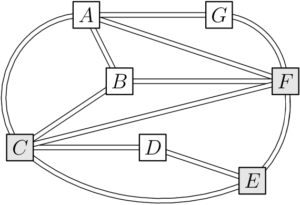
The Konigsberg School has assigned grades 1 through 7 to pods $A$ through $G$, one grade per pod. Some of the pods are connected by walkways, as shown in the figure below. The school noticed that each pair of connected pods has been assigned grades differing by 2 or more grade levels. (For example, grades 1 and 2 will not be in pods directly connected by a walkway.) What is the sum of the grade levels assigned to pods $C, E$, and $F$?

$\textbf{(A)}~12\qquad\textbf{(B)}~13\qquad\textbf{(C)}~14\qquad\textbf{(D)}~15\qquad\textbf{(E)}~16$


$\textbf{A}$
 
Note that both $C$ and $F$ are connected to five other pods. This implies that $C$ and $F$ must contain grades 1 and 7 in either order (if $C$ or $F$ contained any of grades 2, 3, 4, 5, or 6, then there would only be four possible grades for five pods, a contradiction). We assume that pod $C$ is assigned grade 1, and pod $F$ is assigned grade 7.
 
Next, pod $D$ is the only pod which is not adjacent to pod $F$, so pod $D$ must be assigned grade 6. Similarly, pod $G$ must be assigned grade 2.
 
Lastly, we need to assign grades 3, 4, and 5 to pods $A$, $B$, and $E$. Note that $A$ and $B$ are adjacent, so pods $A$ and $B$ must contain grades 3 and 5. Therefore, $E$ must be assigned grade 4. 
 
Hence, the sum of the grade levels assigned to pods $C, E$, and $F$ is $1+4+7 = 12$.

A classroom has a row of 35 coat hooks. Paulina likes coats to be equally spaced, so that there is the same number of empty hooks before the first coat, after the last coat, and between every coat and the next one. Suppose there is at least 1 coat and at least 1 empty hook. How many different numbers of coats can satisfy Paulina's pattern?
 
 
$\textbf{(A)}\ 2\qquad \textbf{(B)}\ 4\qquad \textbf{(C)}\ 5\qquad \textbf{(D)}\ 7\qquad \textbf{(E)}\ 9$

$\textbf{D}$
 
Suppose Paulina has $n$ coats. That will divide the 35 hooks into $n+1$ spaces and $35-n$ empty hooks. Therefore, $35-n$ is divisible by $n+1$ \[n+1|35-n\]The values of $n$ that satisfy this are\[n\in{1,2,3,5,8,11,17}\]The answer is $D$.

$\textbf{B}$

Property II implies that the perfect square must end in $00$ because $...99+1=...00$ (Property I). Four-digit perfect squares ending in $00$ are $\{40, 50, 60, 70, 80, 90\}$. Besides, we need to add 100 to the list.

Property II also says the number is in the form $n^2-1$. By the Difference of Squares, $n^2-1 = (n+1)(n-1)$. Hence: \begin{align*}
40^2-1 &= 39\times41\\
50^2-1 &= 49\times51\\
60^2-1 &= 59\times61\\
70^2-1 &= 69\times71\\
80^2-1 &= 79\times81\\
90^2-1 &= 89\times91\\
100^2-1 &= 99\times101
\end{align*} On this list, the only number that is the product of $2$ prime numbers (Property III) is $60^2-1 = 59\times61$. So the answer is $B$.

$\textbf{B}$
 
Property II implies that the perfect square must end in $00$ because $...99+1=...00$ (Property I). Four-digit perfect squares ending in $00$ are $\{40, 50, 60, 70, 80, 90\}$. Besides, we need to add 100 to the list.
 
Property II also says the number is in the form $n^2-1$. By the Difference of Squares, $n^2-1 = (n+1)(n-1)$. Hence: \begin{align*}
40^2-1 &= 39\times41\\
    50^2-1 &= 49\times51\\
60^2-1 &= 59\times61\\
    70^2-1 &= 69\times71\\
80^2-1 &= 79\times81\\
90^2-1 &= 89\times91\\
100^2-1 &= 99\times101
\end{align*} On this list, the only number that is the product of $2$ prime numbers (Property III) is $60^2-1 = 59\times61$. So the answer is $B$.

In trapezoid $ABCD$, angles $B$ and $C$ measure $60^\circ$ and $AB = DC$. The side lengths are all positive integers, and the perimeter of $ABCD$ is $30$ units. How many non-congruent trapezoids satisfy all of these conditions?
 
 
$\textbf{(A)}\ 0 \qquad \textbf{(B)}\ 1 \qquad \textbf{(C)}\ 2 \qquad \textbf{(D)}\ 3 \qquad \textbf{(E)}\ 4$

$\textbf{E}$
 
Let $AB=CD=a$, $AD=b$. Since $\angle B=\angle C=60^\circ$, we have $BC=\dfrac12a+b+\dfrac12a=a+b$. Therefore, the perimeter of the trapezoid $ABCD$ is $$AB+BC+CD+DA=a+(a+b)+a+b=3a+2b=30$$ Positive integer pairs $(a, b)$ could be $(2,12), (4,9), (6,6), (8,3)$. So the answer is $E$.

Makayla finds all the possible ways to draw a path in a $5 \times 5$ diamond-shaped grid. Each path starts at the bottom of the grid and ends at the top, always moving one unit northeast or northwest. She computes the area of the region between each path and the right side of the grid. Two examples are shown in the figures below. What is the sum of the areas determined by all possible paths?
 
 
$\textbf{(A)}\ 2520 \qquad \textbf{(B)}\ 3150 \qquad \textbf{(C)}\ 3840 \qquad \textbf{(D)}\ 4730 \qquad \textbf{(E)}\ 5050$

$\textbf{B}$
 
Each path from the bottom to the top contains 10 steps, where 5 of them moving northeast, and the rest 5 steps northwest. So the total number of paths is  $$\dbinom{10}{5}=\dfrac{10\times9\times8\times7\times6}{5\times4\times3\times2\times1}=252$$ Each path divides the diamond-shaped grid into two parts: the left side and the right side. We want to find the sum of the areas of the right sides for all paths. Let $R$ be the sum of the areas of the right sides, and $L$ be the sum of the areas of the left sides. By symmetry, we have $L=R$, and the sum of them is $$L+R=252\times25=6300$$ Hence, the answer is $R=\dfrac12\times6300=3150$.

guest

0 Comments
Inline Feedbacks
View all comments
0
Would love your thoughts, please comment.x
()
x