AMC 8 2026

Instructions

  1. This is a 25-question, multiple choice test. Each question is followed by answers marked A, B, C, D and E. Only one of these is correct.
  2. You will receive 1 point for each correct answer. There is no penalty for wrong answers.
  3. No aids are permitted other than plain scratch paper, writing utensils, ruler, and erasers. In particular, graph paper, compass, protractor, calculators, computers, smartwatches, and smartphones are not permitted.
  4. Figures are not necessarily drawn to scale.
  5. You will have 40 minutes working time to complete the test.

What is the value of the following expression?$$1+2-3+4+5-6+7+8-9+10+11-12$$

$\textbf{(A)}\ 18 \qquad \textbf{(B)}\ 21 \qquad \textbf{(C)}\ 24 \qquad \textbf{(D)}\ 27 \qquad \textbf{(E)}\ 30$

$\textbf{A}$
$$(1+2-3)+(4+5-6)+(7+8-9)+(10+11-12)=0+3+6+9=18$$

In the array shown below, three $3$s are surrounded by $2$s, which are in turn surrounded by a border of $1$s. What is the sum of the numbers in the array?

\[\begin{array}{ccccccc} 1 & 1 & 1 & 1 & 1 & 1 & 1 \\ 1 & 2 & 2 & 2 & 2 & 2 & 1 \\ 1 & 2 & 3 & 3 & 3 & 2 & 1 \\ 1 & 2 & 2 & 2 & 2 & 2 & 1 \\ 1 & 1 & 1 & 1 & 1 & 1 & 1 \end{array}\]
$\textbf{(A)}\ 49 \qquad \textbf{(B)}\ 51 \qquad \textbf{(C)}\ 53 \qquad \textbf{(D)}\ 55 \qquad \textbf{(E)}\ 57$

$\textbf{C}$

There are twenty 1s, twelve 2s, and three 3s in the array. So the sum of them is $20\times1+12\times2+3\times3=53$.

Haruki has a piece of wire that is $24$ centimeters long. He wants to bend it to form each of the following shapes, one at a time.

$\bullet\ $ A regular hexagon with side length $5$ cm.$\newline$
$\bullet\ $ A square of area $36\ \text{cm}^2$.$\newline$
$\bullet\ $ A right triangle whose legs are $6$ and $8$ cm long.

Which of the shapes can Haruki make?

$\textbf{(A) }\text{Triangle only}\qquad \newline$
$\textbf{(B) }\text{Hexagon and square only}\newline$
$\textbf{(C) }\text{Hexagon and triangle only}\qquad \newline$
$\textbf{(D) }\text{Square and triangle only}\newline $
$\textbf{(E) }\text{Hexagon, triangle, and square}$

$\textbf{D}$


To solve this problem we can find the perimeter of each of the given spaces and check if it is no great than 24.


$\bullet\quad$ The first shape is a regular hexagon with side length $5$. The hexagon has a perimeter of $6 \times 5 = 30$ centimeters.
$\bullet\quad$ The second shape is a square with area $36$ or a side length of $6$. Then the perimeter of all $4$ sides is $24$ centimeters.
$\bullet\quad$ The hypotenuse of the right triangle with legs $6$ and $8$ centimeters is $10$. So the perimeter of the right triangle is $6 + 8 + 10 = 24$ centimeters.

Thus, only the square and the triangle can be made with 24 centimeters of wire. So the answer is D.

Brynn's savings decreased by $20\%$ in July, then increased by $50\%$ of the new amount in August. Brynn's savings are now what percent of the original amount?

$\textbf{(A)}\ 80 \qquad \textbf{(B)}\ 90 \qquad \textbf{(C)}\ 100 \qquad \textbf{(D)}\ 110 \qquad \textbf{(E)}\ 120$

$\textbf{E}$

Now Brynn's saving is $(1-20\%)(1+50\%)=120\%$ of the original amount. So the answer is E.

Casey went on a road trip that covered $100$ miles, stopping only for a lunch break along the way. The trip took $3$ hours in total and her average speed while driving was $40$ miles per hour. In minutes, how long was the lunch break?
 
$\textbf{(A) }15 \qquad \textbf{(B) }30 \qquad \textbf{(C) }40 \qquad \textbf{(D) }45 \qquad \textbf{(E) }60$

$\textbf{B}$

She drove 100 miles at an average speed of 40 miles per hour. So the driving time is $100/40=2.5$ hours. The total trip time is 3 hours, so the lunch break time is $3-2.5=0.5\ \text{hour}=30\ \text{min}$.

Peter lives near a rectangular field that is filled with blackberry bushes. The field is $10$ meters long and $8$ meters wide, and Peter can reach any blackberries that are within $1$ meter of an edge of the field. The portion of the field he can reach is shaded in the figure below. What fraction of the area of the field can Peter reach?


$\textbf{(A) } \dfrac{1}{6}\qquad\textbf{(B) } \dfrac{1}{4}\qquad\textbf{(C) } \dfrac{1}{3}\qquad\textbf{(D) } \dfrac{3}{8}\qquad\textbf{(E) } \dfrac{2}{5}\qquad$

$\textbf{E}$

The total area of the field is $8\times10=80\ \text{m}^2$. Peter can reach all points within 1 meter of the boundary. That means the unreachable part is the inner rectangle formed by removing 1 meter from each side. Hence, the unreachable area is $6\times8=48\ \text{m}^2$, and the reachable area is $80-48=32\ \text{m}^2$. So the answer is $\dfrac{32}{80}=\dfrac25$.

Mika would like to estimate how far she can ride a new model of electric bike on a fully charged battery. She completed two trips totaling $40$ miles. The first trip used $\dfrac{1}{2}$ of the total battery power, while the second trip used $\dfrac{3}{10}$ of the total battery power. How many miles can this electric bike go on a fully charged battery?

$\textbf{(A) } 45\qquad\textbf{(B) } 48\qquad\textbf{(C) } 50\qquad\textbf{(D) } 52\qquad\textbf{(E) } 55\qquad$

$\textbf{C}$

40 miles corresponds to $\dfrac12+\dfrac{3}{10}=\dfrac45$ of the total battery. So the bike can travel $40\div\dfrac45=50$ miles on a full charge.

A poll asked a number of people if they liked solving mathematics problems. Exactly $74\%$ answered “yes.” What is the fewest possible number of people who could have been asked the question?

$\textbf{(A)}\ 10 \qquad \textbf{(B)}\ 20 \qquad \textbf{(C)}\ 25 \qquad \textbf{(D)}\ 50 \qquad \textbf{(E)}\ 100$

$\textbf{D}$

Let $x$ be the number of people who have been asked the question. Then $74\%x=\dfrac{74}{100}x=\dfrac{37}{50}x$ people answered yes. To make $\dfrac{37}{50}x$ a integer, $x$ must be a multiple of 50. Hence, the minimum value of $x$ is 50.

What is the value of this expression? \[\dfrac{\sqrt{16\sqrt{81}}}{\sqrt{81\sqrt{16}}}\]

$\textbf{(A) } \dfrac{4}{9}\qquad\textbf{(B) } \dfrac{2}{3}\qquad\textbf{(C) } 1\qquad\textbf{(D) } \dfrac{3}{2}\qquad\textbf{(E) } \dfrac{9}{4}$

$\textbf{B}$

\[\dfrac{\sqrt{16\sqrt{81}}}{\sqrt{81\sqrt{16}}}=\dfrac{\sqrt{16\times9}}{\sqrt{81\times4}}=\dfrac{4\times3}{9\times2}=\dfrac23\]

Five runners completed the grueling Xmarathon: Luke, Melina, Nico, Olympia, and Pedro.

$\bullet\ $ Nico finished $11$ minutes behind Pedro.$\newline$
$\bullet\ $ Olympia finished $2$ minutes ahead of Melina, but $3$ minutes behind Pedro.$\newline$
$\bullet\ $ Olympia finished $6$ minutes ahead of Luke.

Which runner finished fourth?

$\textbf{(A) }\text{Luke} \qquad \textbf{(B) }\text{Melina} \qquad \textbf{(C) }\text{Nico} \qquad \textbf{(D) }\text{Olympia}\qquad \textbf{(E) }\text{Pedro}$

$\textbf{A}$

Let $L,M,N,O,P$ be the time in minutes for each runner to complete the marathon. According to the given information, we can list these five numbers in the time axis:


Hence, the order from smallest time (fastest) to largest time is $P<O<M<L<N$. The runner who finished fourth is Luke.

Squares of side length $1$, $1$, $2$, $3$, and $5$ are arranged to form the rectangle shown below. A curve is drawn by inscribing a quarter circle in each square and joining the quarter circles in order, from shortest to longest. What is the length of the curve?


$\textbf{(A) } 4\pi\qquad\textbf{(B) } 6\pi\qquad\textbf{(C) } \dfrac{13}{2}\pi\qquad\textbf{(D) } 8\pi\qquad\textbf{(E) } 13\pi$

$\textbf{B}$

The length of a quarter circle is $\dfrac14\times2\pi r=\dfrac12\pi r$, where $r$ is the radius of the circle. In this question the radius of each circle is equal to the side length of each square. Hence, the length of the curve is $\dfrac12\pi(1+1+2+3+5)=6\pi$.

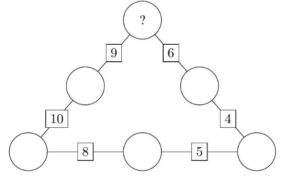
In the figure below, each circle will be filled with a digit from $1$ to $6$. Each digit must appear exactly once. The sum of the digits in neighboring circles is shown in the box between them. What digit must be placed in the top circle?
 

$\textbf{(A) } 2\qquad\textbf{(B) } 3\qquad\textbf{(C) } 4\qquad\textbf{(D) } 5\qquad\textbf{(E) } \text{it is impossible to fill the circles}$

$\textbf{D}$

In the bottom-left corner, we have 2 numbers that add up to 10 filled in from the digits from $1$ to $6$. There are two ways you can do this, $5$ and $5$ or $6$ and $4$. Since we can only use each integer once, the first case doesn't work, so we must have the second case. Now we need to figure out the ordering. If we have $4$ by the $8$, the other circle adjacent to 8 must be $4$, but again, we can only use each integer once, so the $6$ must be by the $8$, and the $4$ must be by the $10$ and the $9$. Therefore, the digit in the top circle must be 5.

The figure below shows a tiling of $1\times1$ unit squares. Each row of unit squares is shifted horizontally by half a unit relative to the row above it. A shaded square is drawn on top of the tiling. Each vertex of the shaded square is a vertex of one of the unit squares. In square units, what is the area of the shaded square?


$\textbf{(A) } 10\qquad\textbf{(B) } \dfrac{21}{2}\qquad\textbf{(C) } \dfrac{32}{3}\qquad\textbf{(D) } 11\qquad\textbf{(E) } \dfrac{34}{3}$

$\textbf{A}$

Each side of the shaded square is the hypotenuse of a right triangle which has legs 1 and 3. Thus, the side length of the shaded square is $\sqrt{3^2+1^2}=\sqrt{10}$, so its area is 10.

Jami picked three equally spaced integer numbers on the number line. The sum of the first and the second numbers is $40$, while the sum of the second and third numbers is $60$. What is the sum of all three numbers?

$\textbf{(A)}\ 70 \qquad \textbf{(B)}\ 75 \qquad \textbf{(C)}\ 80 \qquad \textbf{(D)}\ 85 \qquad \textbf{(E)}\ 90$

$\textbf{B}$

Let the three equally spaced integers be $x-d$, $x$, and $x+d$. Given that $$(x-d)+x=40$$ $$x+(x+d)=60$$ Solving, we get $x=25$, $d=10$. So the sum of all three number is $(x-d)+x+(x+d)=3x=75$.

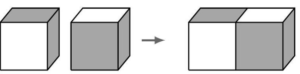
Elijah has a large collection of identical wooden cubes which are white on $4$ faces and gray on $2$ faces that share an edge. He glues some cubes together face-to-face. The figure below shows $2$ cubes being glued together, leaving $3$ gray faces visible. What is the fewest number of cubes that he could glue together to ensure that no gray faces are visible, no matter how he rotates the figure?

$\textbf{(A)}\ 4 \qquad\textbf{(B)}\ 6 \qquad\textbf{(C)}\ 8 \qquad\textbf{(D)}\ 9 \qquad\textbf{(E)}\ 27$

$\textbf{A}$
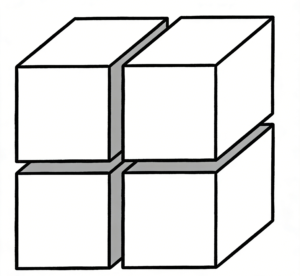
 

In order to minimize the number of cubes used, we try to combine gray sides with gray sides and avoid combining white and gray sides. In the figure above we have $4$ cubes with all their gray faces facing each other, and that makes no gray faces visible. Hence, the answer is A.

Consider all positive four-digit integers consisting of only even digits. What fraction of these integers are divisible by 4?

$\textbf{(A) } \dfrac{1}{4} \qquad \textbf{(B) } \dfrac{2}{5} \qquad \textbf{(C) } \dfrac{1}{2} \qquad \textbf{(D) } \dfrac{3}{5} \qquad \textbf{(E) } \dfrac{3}{4}$

$\textbf{D}$

A number is divisible by 4 if and only if the last two digits are divisible by 4. Hence, we only need to focus on the last two digits. Furthermore, we notice that the tens digit also doesn't matter because the tens digit must be even, and thus a multiple of 4. Therefore, we only care about the ones digit. We have the even digits $0$, $2$, $4$, $6$, and $8$, and there are 3 digits that are divisible by $4$, namely $0$, $4$, and $8$, out of $5$ total digits, so we have the final fraction $\dfrac{3}{5}$.

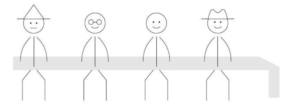
Four students are seated in a row. They chat with the people sitting next to them, then rearrange themselves so that they are no longer seated next to any of the same people. How many rearrangements are possible?

$\textbf{(A)}\ 2 \qquad\textbf{(B)}\ 4 \qquad\textbf{(C)}\ 9 \qquad\textbf{(D)}\ 12 \qquad\textbf{(E)}\ 24$

$\textbf{A}$

Let's say the students are $A$, $B$, $C$, and $D$, and they seated in the order $ABCD$ at first. Since $B$ sits next to both $A$ and $C$, after rearrangement $B$ can only sit next to $D$. The only way to achieve that is if $B$ sits at either the front or the back. We can apply the same logic to $C.$ There are now two cases: $BDAC$ and $CADB$. Therefore, the answer is A.

In how many ways can $60$ be written as the sum of two or more consecutive odd positive integers that are arranged in increasing order?

$\textbf{(A) } 1\qquad\textbf{(B) } 2\qquad\textbf{(C) } 3\qquad\textbf{(D) } 4\qquad\textbf{(E) } 5$

$\textbf{B}$

Let $n$ be the first number in such a series, and $k$ be the number of terms in the series. Then the sum of the series is $$n + (n+2) + \cdots + (n+2(k-1)) =k(n+k-1)$$ The goal is to find all solutions to the equation $k(n+k-1)= 60$, where $n$ is an odd positive integer and $k\geq 2$ is an integer. If $k$ is odd, then $k(n+k-1)$ must be odd, but $60$ is clearly not odd. Thus, we know $k$ is even.

Consider the following cases:

$\bullet\quad$ Case 1: $k=2$. Then $2(n+1) = 60$, which yields a valid solution in $n = 29$ and the series $29 + 31$.

$\bullet\quad$ Case 2: $k=4$. Then $4(n+3)= 60$, which yields an invalid solution in $n = 12$.

$\bullet\quad$ Case 3: $k=6$. Then $6(n+5) = 60$, which yields a valid solution in $n = 5$ and the series $5 + 7 + 9 + 11 + 13 + 15$.

$\bullet\quad$ Case 4: $k=8$. Then $8(n+7)= 60$, which yields an invalid solution in $n = \dfrac{1}{2}$.

$\bullet\quad$ Case 5: $k \geq 9$. Then $k(n+k-1)> k(k-1) > 60$, so there will be no more valid solutions.

Hence, there are 2 such series. The answer is B.

Miguel is walking with his dog, Luna. When they reach the entrance to a park, Miguel throws a ball straight ahead and continues to walk at a steady pace. Luna sprints toward the ball, which stops by a tree. As soon as the dog reaches the ball, she brings it back to Miguel. Luna runs $5$ times faster than Miguel walks. What fraction of the distance between the entrance and the tree does Miguel cover by the time Luna brings him the ball?


$\textbf{(A) } \dfrac{1}{6}\qquad\textbf{(B) } \dfrac{1}{5}\qquad\textbf{(C) } \dfrac{1}{4}\qquad\textbf{(D) } \dfrac{1}{3}\qquad\textbf{(E) } \dfrac{2}{5}$

$\textbf{D}$

Since Luna's speed is 5 time as fast as Miguel, Miguel has covered $\dfrac1{1+5}=\dfrac16$ of the total distance. Note that the total distance is twice the distance between the entrance and the tree. So the fraction sought in this question is $2\times\dfrac16=\dfrac13$.

The land of Catania uses gold coins and silver coins. Gold coins are $1$ mm thick and silver coins are $3$ mm thick. In how many ways can Taylor make a stack of coins that is $8$ mm tall using any arrangement of gold and silver coins, assuming order matters?

$\textbf{(A) } 3\qquad\textbf{(B) } 7\qquad\textbf{(C) } 10\qquad\textbf{(D) } 13\qquad\textbf{(E) } 16$

$\textbf{D}$

Let $x$ be the number of gold coins, and let $y$ be the number of silver coins. Since the stack of coins is 8 mm tall, $y$ can be no more than 2. Now we can use casework to find all possible stacks.

$\textbf{Case 1}$: If $y=0$, then there is only one way to make the stack of coins, which is $8$ gold coins.

$\textbf{Case 2}$: If $y=1$, then there must be $5$ gold coins. There are $6$ coins in total, and we can put the silver coin anywhere in the stack, so there are $\dbinom{6}{1}=6$ ways to place the silver coin, giving $6$ different possible stacks with $1$ silver coin. (Note that when you place the silver coin anywhere, the rest of the stack is predetermined, because the rest of the stack must be gold, so we only have to account for one type of coin, in this case, the silver coin.)

$\textbf{Case 3}$: If $y=2$, then there must be $2$ gold coins, so we have 4 coins in total. We can distribute the $2$ silver coins in $\dbinom{4}{2}=6$ different ways, giving $6$ possible stacks with $2$ silver coins. (Again, note that wherever you place the silver coins, the rest of the stack is predetermined, because the rest of the stack must be gold, so we only have to account for one type of coin, in this case, the silver coin.)

Adding all the possible number of cases in all $3$ cases gives $1+6+6=13$, thus the answer is D.

Charlotte the spider is walking along a web shaped like a $5$-pointed star, shown in the figure below. The web has $5$ outer points and $5$ inner points. Each time Charlotte reaches a point, she randomly chooses a neighboring point and moves to that point. Charlotte starts at one of the outer points and makes $3$ moves (re-visiting points is allowed). What is the probability she is now at one of the outer points of the star?


$\textbf{(A) } \dfrac{1}{5}\qquad\textbf{(B) } \dfrac{1}{4}\qquad\textbf{(C) } \dfrac{2}{5}\qquad\textbf{(D) } \dfrac{1}{2}\qquad\textbf{(E) } \dfrac{3}{5}$

$\textbf{B}$

After the first step she will land on an inner point. Next, there are four adjacent points, where two of them are inner, and the other two are outer. Thus, there is a $\dfrac{1}{2}$ probability for both. If it is outer, the final move can't land on an outer point. If it is inner, there is, again, a $\dfrac{1}{2}$ probability that the next one is outer. Therefore, the final probability is $\dfrac{1}{2} \times \dfrac{1}{2} = \dfrac{1}{4}$.

The integers from $1$ to $25$ are arbitrarily separated into five groups of $5$ numbers each. The median of each group is identified. Let $M$ equal the median of the five medians. What is the least possible value of $M$?

$\textbf{(A) } 9\qquad\textbf{(B) } 10\qquad\textbf{(C) } 12\qquad\textbf{(D) } 13\qquad\textbf{(E) } 14$

$\textbf{A}$

If a group has median $m$, then $3$ of the numbers in that group are no more than $m$. Since there are 5 different groups, $3$ groups must have a median no more than $M$, so there are at least $3\times3=9$ numbers that are no more than $M$. Thus, the least possible value of $M$ is 9.

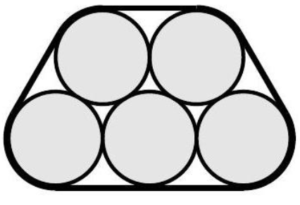
Lakshmi has $5$ round coins of diameter $4$ centimeters. She arranges the coins in $2$ rows on a table top, as shown below, and wraps an elastic band tightly around them. In centimeters, what will be the length of the band?

$\textbf{(A)}\ 2\pi + 20 \qquad \textbf{(B)}\ \dfrac{5}{2}\pi + 20 \qquad \textbf{(C)}\ 4\pi + 20 \qquad \textbf{(D)}\ \dfrac{9}{2}\pi + 20 \qquad \textbf{(E)}\ 5\pi + 20$

$\textbf{C}$


In order to find the length of the elastic band, perpendicular lines are added to the figure to divide the band into sections for easier calculation. After the additions, the length of band consist of 5 identical lines and 4 arcs. The length of each line is equal to the diameter of a circle. 4 arcs make a full circle, and thus the sum of them is the circumference of a circle. Hence, the length of the elastic band is $5\times4+4\pi=4\pi+20$.

The notation $n!$ (read “n factorial”) is defined as the product of the first $n$ positive integers. (For example, $3! = 1 \cdot 2 \cdot 3 = 6$.) Define the superfactorial of a positive number, denoted by $n^{!}$, to be the product of the factorials of the first $n$ integers. (For example, $3^{!} = 1! \cdot 2! \cdot 3! = 12$.) How many factors of $7$ appear in the prime factorization of $51^{!}$, the superfactorial of $51$?

$\textbf{(A)}\ 147 \qquad \textbf{(B)}\ 150 \qquad \textbf{(C)}\ 156 \qquad \textbf{(D)}\ 168 \qquad \textbf{(E)}\ 171$

$\textbf{E}$

From $7! - 13!$, there is $1$ power of $7$ each. From $14! - 20!$, there are $2$ powers each. From $21! - 27!$, $3$ powers each. From $28! - 34!$, $4$ powers each. From $35! - 41!$, $5$ powers each. From $42! - 48!$, $6$ powers each. Finally, from $49!$ to $51!$, there are $8$ powers each because factor 49 contribute $2$ powers of $7$. Thus, the number of powers in total is $$7\times1+7\times2+7\times3+7\times4+7\times5+7\times6+3\times8=171$$

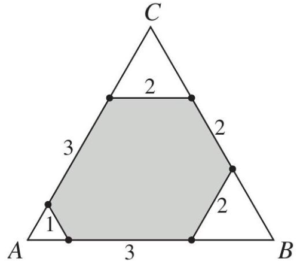
In an equiangular hexagon, all interior angles measure $120^\circ$. An example of such a hexagon with side lengths $2$, $3$, $1$, $3$, $2$, and $2$ is shown below, inscribed in equilateral triangle $ABC$. Consider all equiangular hexagons with positive integer side lengths that can be inscribed in $\triangle ABC$, with all six vertices on the sides of the triangle. What is the total number of such hexagons? Hexagons that differ only by a rotation or a reflection are considered the same.

$\textbf{(A) } 4\qquad\textbf{(B) } 5\qquad\textbf{(C) } 6\qquad\textbf{(D) } 7\qquad\textbf{(E) } 8$

$\textbf{E}$

Note that the unshaded region in the figure consist of 3 equilateral triangles. The hexagon can be obtained by cutting off 3 equilateral corner triangles.

Let the side lengths of the 3 cut-off equilateral triangles at $A,B,C$ be $x,y,z$. Thus, going around the hexagon, its 6 side lengths are $6-x-y, y, 6-y-z, z, 6-z-x, x$. Since all side lengths are positive integers, we have \[x+y\le 5\] \[y+z\le 5\]\[z+x\le 5 \] where $x,y,z$ are all positive integers.

Two hexagons that differ only by a rotation or reflection correspond to different arrangements of the same triple $(x,y,z)$. To eliminate that, we assume $1\le x\le y\le z$. Then we try to enumerate all possible triples $(x,y,z)$.

If $x=1$, then $1+y\le 5\Rightarrow y\le 4$ and $1+z\le 5\Rightarrow z\le 4$. Also $y\le z$ and $y+z\le 5$. The valid triples are: $(1,1,1),\ (1,1,2),\ (1,1,3),\ (1,1,4),\ (1,2,2),\ (1,2,3).$

If $x=2$, then $2+y\le 5\Rightarrow y\le 3$ and $2+z\le 5\Rightarrow z\le 3$. Also $y\le z$ and $y+z\le 5$. The valid triples are: $(2,2,2),\ (2,2,3).$

If $x\ge 3$, then $x+y\ge 3+3=6>5$, impossible.

So there are $6+2=8$ valid triples, which lead to $8$ distinct hexagons. The answer is E.

guest

0 Comments
Inline Feedbacks
View all comments
0
Would love your thoughts, please comment.x
()
x